


Page 37 - Annual Report
P. 37
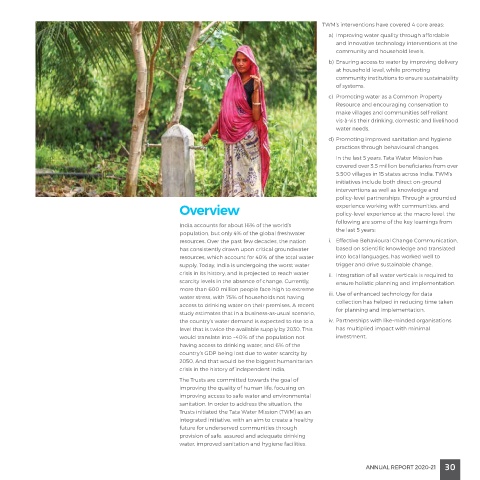
TWM’s interventions have covered 4 core areas:
                                                                                                                 a)  Improving water quality through affordable
                                                                                                                 and innovative technology interventions at the
                                                                                                                 community and household levels.
                                                                                                                 b)  Ensuring access to water by improving delivery
                                                                                                                 at household level, while promoting
                                                                                                                 community institutions to ensure sustainability
                                                                                                                 of systems.
                                                                                                                 c)  Promoting water as a Common Property
                                                                                                                 Resource and encouraging conservation to
                                                                                                                 make villages and communities self-reliant
                                                                                                                 vis-à-vis their drinking, domestic and livelihood
                                                                                                                 water needs.
                                                                                                                 d)  Promoting improved sanitation and hygiene
                                                                                                                 practices through behavioural changes.
                                                                                                                 In the last 5 years, Tata Water Mission has
                                                                                                                 covered over 3.5 million beneficiaries from over
                                                                                                                 5,500 villages in 15 states across India. TWM’s
                                                                                                                 initiatives include both direct on-ground
                                                                                                                 interventions as well as knowledge and
                                                                                                                 policy-level partnerships. Through a grounded
                                                                  Overview                                       experience working with communities, and
                                                                                                                 policy-level experience at the macro level, the
                                                                                                                 following are some of the key learnings from
                                                                  India accounts for about 16% of the world’s
                                                                  population, but only 4% of the global freshwater   the last 5 years:
                                                                  resources. Over the past few decades, the nation       i.   Effective Behavioural Change Communication,
                                                                  has consistently drawn upon critical groundwater   based on scientific knowledge and translated
                                                                  resources, which account for 40% of the total water   into local languages, has worked well to
                                                                  supply. Today, India is undergoing the worst water   trigger and drive sustainable change.
                                                                  crisis in its history, and is projected to reach water       ii.  Integration of all water verticals is required to
                                                                  scarcity levels in the absence of change. Currently,   ensure holistic planning and implementation.
                                                                  more than 600 million people face high to extreme
                                                                  water stress, with 75% of households not having       iii.  Use of enhanced technology for data
                                                                  access to drinking water on their premises. A recent   collection has helped in reducing time taken
                                                                  study estimates that in a business-as-usual scenario,   for planning and implementation.
                                                                  the country’s water demand is expected to rise to a       iv.  Partnerships with like-minded organisations
                                                                  level that is twice the available supply by 2030. This   has multiplied impact with minimal
                                                                  would translate into ~40% of the population not   investment.
                                                                  having access to drinking water, and 6% of the
                                                                  country’s GDP being lost due to water scarcity by
                                                                  2050. And that would be the biggest humanitarian
                                                                  crisis in the history of independent India.
                                                                  The Trusts are committed towards the goal of
                                                                  improving the quality of human life, focusing on
                                                                  improving access to safe water and environmental
                                                                  sanitation. In order to address the situation, the
                                                                  Trusts initiated the Tata Water Mission (TWM) as an
                                                                  integrated initiative, with an aim to create a healthy
                                                                  future for underserved communities through
                                                                  provision of safe, assured and adequate drinking
                                                                  water, improved sanitation and hygiene facilities.


                                                                                                                          ANNUAL REPORT 2020-21 30

