


Page 40 - Annual Report
P. 40
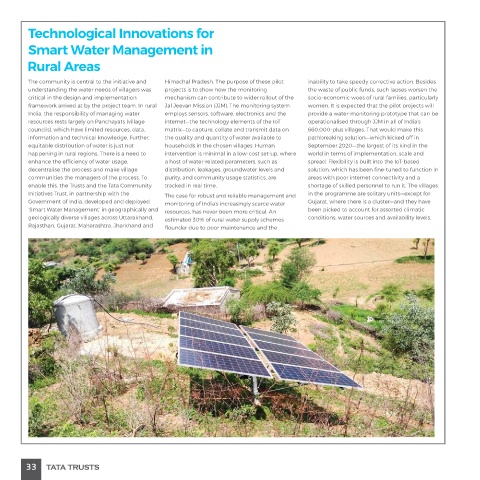
Technological Innovations for

                    Smart Water Management in


                    Rural Areas

                    The community is central to the initiative and   Himachal Pradesh. The purpose of these pilot   inability to take speedy corrective action. Besides
                    understanding the water needs of villagers was   projects is to show how the monitoring   the waste of public funds, such lapses worsen the
                    critical in the design and implementation   mechanism can contribute to wider rollout of the   socio-economic woes of rural families, particularly
                    framework arrived at by the project team. In rural   Jal Jeevan Mission (JJM). The monitoring system   women. It is expected that the pilot projects will
                    India, the responsibility of managing water   employs sensors, software, electronics and the   provide a water-monitoring prototype that can be
                    resources rests largely on Panchayats (village   internet—the technology elements of the IoT   operationalised through JJM in all of India’s
                    councils), which have limited resources, data,   matrix—to capture, collate and transmit data on   660,000-plus villages. That would make this
                    information and technical knowledge. Further,   the quality and quantity of water available to   pathbreaking solution—which kicked off in
                    equitable distribution of water is just not   households in the chosen villages. Human   September 2020—the largest of its kind in the
                    happening in rural regions. There is a need to   intervention is minimal in a low-cost set-up, where   world in terms of implementation, scale and
                    enhance the efficiency of water usage,    a host of water-related parameters, such as   spread. Flexibility is built into the IoT-based
                    decentralise the process and make village   distribution, leakages, groundwater levels and   solution, which has been fine-tuned to function in
                    communities the managers of the process. To   purity, and community usage statistics, are   areas with poor internet connectivity and a
                    enable this, the Trusts and the Tata Community   tracked in real time.              shortage of skilled personnel to run it. The villages
                    Initiatives Trust, in partnership with the   The case for robust and reliable management and   in the programme are solitary units—except for
                    Government of India, developed and deployed   monitoring of India’s increasingly scarce water   Gujarat, where there is a cluster—and they have
                    ‘Smart Water Management’ in geographically and   resources, has never been more critical. An   been picked to account for assorted climatic
                    geologically diverse villages across Uttarakhand,   estimated 30% of rural water supply schemes   conditions, water sources and availability levels.
                    Rajasthan, Gujarat, Maharashtra, Jharkhand and   flounder due to poor maintenance and the


                      00
                    33

