


Page 39 - Annual Report
P. 39
Impact
The Trusts supported the Government of
Andhra Pradesh in the implementation of
Swachh Bharat Mission Gramin in 970 Gram
Panchayats in Krishna district. Over 22,000
households benefited through the support. An
assessment revealed:
(a) Access to sanitation coverage has increased
from 13% to 99% in project geographies.
(b) Reduction in disease burden of up to
30% based on evidence from interactions
with Primary Healthcare Centres/village
administration.
(c) Maintenance of toilets was observed as
‘Good’ to ‘Fair’ across 85% of households.
(d) More than 97% of family members regularly
used toilets.
(e) 39% of beneficiary respondents were able to
recall the awareness components, over 4 years
into project operationalisation.
(f) 91% of beneficiaries washed their hands with
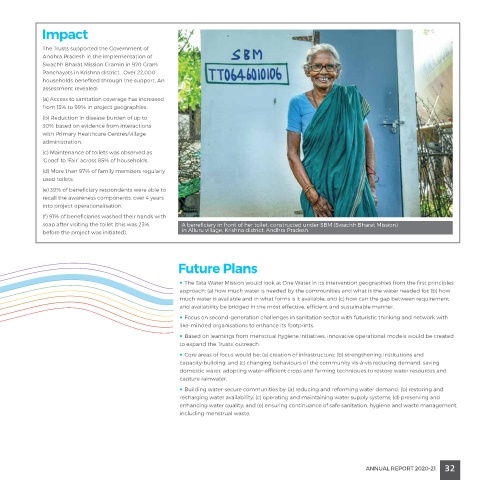
soap after visiting the toilet (this was 23% A beneficiary in front of her toilet, constructed under SBM (Swachh Bharat Mission)
before the project was initiated). in Alluru village, Krishna district, Andhra Pradesh.
Future Plans
The Tata Water Mission would look at One Water in its intervention geographies from the first principles
approach: (a) how much water is needed by the communities and what is the water needed for; (b) how
much water is available and in what forms is it available; and (c) how can the gap between requirement
and availability be bridged in the most effective, efficient and sustainable manner.
Focus on second-generation challenges in sanitation sector with futuristic thinking and network with
like-minded organisations to enhance its footprints.
Based on learnings from menstrual hygiene initiatives, innovative operational models would be created
to expand the Trusts’ outreach.
Core areas of focus would be: (a) creation of infrastructure; (b) strengthening institutions and
capacity-building; and (c) changing behaviours of the community vis-à-vis reducing demand, saving
domestic water, adopting water-efficient crops and farming techniques to restore water resources and
capture rainwater.
Building water-secure communities by: (a) reducing and reforming water demand; (b) restoring and
recharging water availability; (c) operating and maintaining water supply systems; (d) preserving and
enhancing water quality; and (e) ensuring continuance of safe sanitation, hygiene and waste management,
including menstrual waste.
ANNUAL REPORT 2020-21 32

