


Page 41 - Annual Report
P. 41
Transformative


                      Journeys


                                                                                                            open fields – an unhygienic and environmentally
                                                                                                            harmful practice.
                                                                                                            Bechan Gautam says, “ While attending Menstrual
                                                                                                            Hygiene Management (MHM) sessions, my wife had
                                                                                                            learnt about eco-friendly cloth pads and wanted to
                                                                                                            try them. But I think she was too shy to talk to me
                                                                                                            about it and to ask me for money to buy those.”
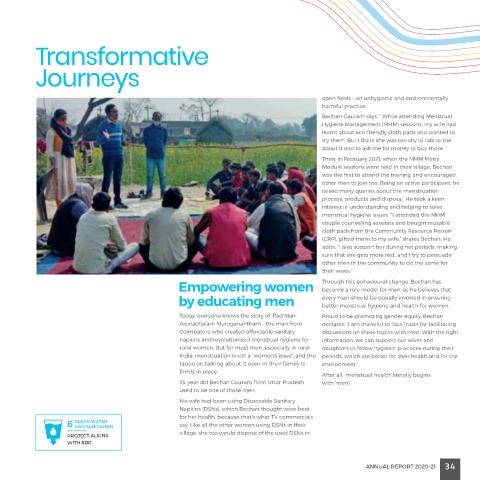
                                                                                                            Then, in February 2021, when the MHM Men’s
                                                                                                            Module sessions were held in their village, Bechan
                                                                                                            was the first to attend the training and encouraged
                                                                                                            other men to join too. Being an active participant, he
                                                                                                            raised many queries about the menstruation
                                                                                                            process, products and disposal. He took a keen
                                                                                                            interest in understanding and helping to solve
                                                                                                            menstrual hygiene issues. “I attended the MHM
                                                                                                            couple counselling sessions and bought reusable
                                                                                                            cloth pads from the Community Resource Person
                                                                                                            (CRP), gifted them to my wife.” shares Bechan. He
                                                                                                            adds, “I also support her during her periods, making
                                                                                                            sure that she gets more rest, and I try to persuade
                                                                                                            other men in the community to do the same for
                                                                                                            their wives.”
                                                                 Empowering women                           Through this behavioural change, Bechan has
                                                                                                            become a role model for men, as he believes that
                                                                 by educating men                           every man should be equally involved in ensuring
                                                                                                            better menstrual hygiene and health for women.
                                                                  Today, everyone knows the story of ‘Pad Man’   Proud to be promoting gender equity, Bechan
                                                                  Arunachalam Muruganantham – the man from   declares: “I am thankful to Tata Trusts for facilitating
                                                                  Coimbatore who created affordable sanitary   discussions on these topics with men. With the right
                                                                  napkins and revolutionised menstrual hygiene for   information, we can support our wives and
                                                                  rural women. But for most men, especially in rural   daughters to follow hygienic practices during their
                                                                  India, menstruation is still a “women’s issue”, and the  periods, which are better for their health and for the
                                                                  taboo on talking about it even in their family is   environment.”
                                                                  firmly in place.
                                                                                                            After all, ‘menstrual health’ literally begins
                                                                  35-year old Bechan Gautam from Uttar Pradesh   with ‘men’!
                                                                  used to be one of those men.
                                                                  His wife had been using Disposable Sanitary
                                                                  Napkins (DSNs), which Bechan thought were best
                                                                  for her health, because that’s what TV commercials
                                6  CLEAN WATER                    say. Like all the other women using DSNs in their
                                  AND SANITATION
                                PROJECT ALIGNS                    village, she too would dispose of the used DSNs in
                                WITH SDG


                                                                                                                          ANNUAL REPORT 2020-21 34

