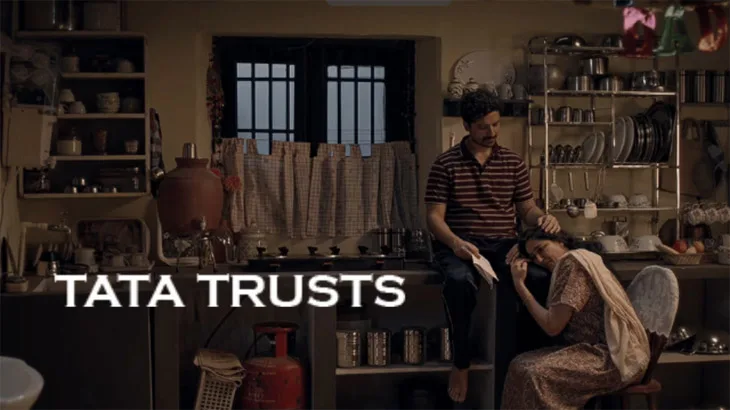
‘Aapka Vajood Rahe Maujood’ moves dementia beyond the familiar language of memory loss and into the intimate space of a mother-son relationship. Creative Director Keegan Pinto and Tata Trusts’ Shilpi Ghosh explain why the campaign had to be about identity, not just memory.
 |
| How Tata Trusts put identity at the centre of its Dementia campaign |
What if dementia is not about forgetting a person but about slowly losing the person you know?
That is the uncomfortable question at the heart of Tata Trusts’ latest dementia awareness campaign, ‘Aapka Vajood Rahe Maujood’.
Rather than build another health-awareness film around memory loss, the campaign looks at the quieter changes that can accompany dementia — repetition, disorientation, withdrawal and changes in behaviour — and asks audiences to see them as something more than the inevitable signs of ageing.
For Shilpi Ghosh, Head of Brand and Marketing Communications, Tata Trusts, that starting point was critical.
“We never build a campaign just for the sake of building one,” she said.
The campaign emerged from qualitative research involving people with early-stage dementia, caregivers, neurologists, psychologists and psychiatrists.
“We speak to patients, to caregivers, patients with early-stage dementia, with neurologists, psychologists, psychiatrists. It’s been a journey of understanding the lived reality of patients with early-stage dementia.”
That lived reality ultimately pushed the campaign beyond the most obvious dementia narrative.
“Memory loss would have been more direct”
For Creative Director Keegan Pinto, the brief became more interesting precisely because it was bigger than memory.
“Memory loss would have been, in my opinion, a little more direct, more simplistic, and less emotional as an opportunity.”
The strategic insight offered another possibility: identity loss.
“The most compelling angle was the possibility of identity loss. It’s more emotionally connected.”
That distinction shaped the film.
Memory loss appears in the story, but it is not allowed to become the entire story. The film also shows repetition, disorientation and isolation — different signs that, together, suggest something larger is happening to the mother.
“I’m not only losing my mama through memory. I’m losing my mama from, for example, she’s isolating herself and not being her mama.”
That is where the title acquires its meaning.
The person may still be physically present. But pieces of the person the family knows are gradually disappearing.
The problem with “it’s just old age”
The creative challenge was also a behavioural one.
In India, cognitive decline can often be dismissed as an inevitable part of getting older. Families may see the signs without recognising them as symptoms of a medical condition.
Ghosh says the campaign therefore had two jobs.
“Our purpose was to correct that misconception or that misattribution, and then help them understand what at a larger level dementia really entailed.”
That meant the film could not simply deliver medical information.
It had to change the way people interpreted familiar behaviour.
“A lot of people didn’t understand the eventual score itself. It was being misattributed to ageing.”
The campaign's challenge, then, was not only to tell people what dementia is.
It was to make them question something they already believed.
“We were conscious of not simplistically doing memory loss”
The mother-son relationship became the vehicle for that shift.
Pinto says the team was deliberately conscious of bringing multiple symptoms together rather than reducing the condition to forgetting. “We were conscious of not simplistically doing memory.”
The film instead builds a cumulative picture.
“There’s also repeating things. There’s also time disorientation. There’s also isolation. So the total symptoms came together to say, ‘I’m losing the entire vajood of my mom.’”
That word — vajood, or existence/selfhood — becomes more powerful than a clinical definition.
The campaign is essentially asking families to notice the difference between someone forgetting something and someone changing in ways that may signal something deeper.
The mother phenomenon
There is a distinctly Indian cultural layer to the storytelling too.
The film is built around a mother-son relationship — a relationship Pinto believes carries enormous emotional currency.
“The number one ranked culture in India is the mother.”
But the team also recognised a second cultural reality: the tendency to delay action on health.
“There is a culture of not moving on health, not moving fast enough on health. Not moving proactively on health, not moving preventively on health.”
That became particularly important because the campaign was focused on early-stage dementia.
The mother in the film isn't presented as someone who has completely lost awareness. She remains intelligent, conscious and recognisably herself.
That was intentional.
“She still has her intelligence. She still has her sense of self and sense of personality.”
The creative objective was to show the importance of recognising the condition early, before more of that identity is lost.
Why make a long film in the age of the scroll?
There is another unusual decision at the centre of the campaign: its length.
In an industry obsessed with six-second hooks, short-form video and shrinking attention spans, the team allowed the story to take its time.
But Pinto insists that creating a long film was never the objective.
“We tried to write 10 seconds, 15 seconds, 30 seconds.”
The problem was that the story refused to cooperate. “It just demanded this story.”
For Ghosh, the emotional relationship itself needed space.
“It was about getting that difficult conversation to sort of take shape and allowing that conversation to sort of take the length that it needed.”
In other words, the team did not decide that longer was better.
The story decided.
And that creates an interesting counterpoint to the industry's current fixation with attention spans.
Perhaps the question isn't always how long an audience will watch.
Perhaps it is whether the story gives them a reason to stay.
“You’re directly writing for people”
For Pinto, working on a public-interest campaign also changes the relationship between the writer and the audience.
“You are directly writing for people. You’re directly writing for human beings.”
Unlike a commercial advertisement, there is no product sitting between the creative idea and the audience.
“You aren’t writing through a product.”
And that changes the responsibility of the work.
“If you’re that close to a human being, you just have to be more human.”
That philosophy is particularly relevant when the subject is dementia.
There is a risk of becoming overly clinical.
There is also a risk of becoming overly sentimental.
The campaign tries to occupy the difficult space between the two: medically responsible, but emotionally recognisable.
"For Tata Trusts, the campaign is only one piece of the puzzle"
For Ghosh, the role of communication cannot be separated from the larger work being done by Tata Trusts.
“The Trusts never look at a problem just as a brand problem or a communication problem. It’s literally the entire continuum.”
That continuum includes access, affordability, advocacy, awareness and interventions on the ground.
Communication, therefore, becomes an amplifier rather than the intervention itself.
“Communication for us is always a layer that we add to our interventions on ground.”
And the purpose of that layer is ultimately to be behavioural.
“Our purpose is to shift attitudes. Our purpose is to change behaviour. Our purpose is to nudge action.”
That also changes the question of measurement.
What does success look like when the metric is a conversation?
Reach and views matter, but they cannot fully capture what a campaign like this is trying to change.
The more meaningful outcome could be much smaller.
A son noticing something different about his mother. A caregiver questioning whether a behaviour is really “just age”. A family deciding to seek medical advice.
Or simply finding the words to talk about something they have been unable to name.
Ghosh says the response to the campaign has gone beyond the outcomes the team initially expected.
“The feedback that we’ve been getting, the love that we’ve been getting from India is unmatched.”
Some reactions have been deeply personal.
“We’ve had grown men breaking down.”
People have shared stories about parents who lived with dementia. Others have found a way to confront grief around someone they had lost.
“It’s helping people reach closure in so many ways, especially for those who have lost a parent with dementia.”
For the team, that emotional response has become its own form of measurement.
“What we’re getting in return is so much more than those outcomes," Ghosh adds.
This article was published on Storyboard 18 on 02 September 2026.
Quick links
Read more about the Dementia Campaign
