India's handloom traditions are not just cultural heritage. They power livelihoods, strengthen rural economies and preserve skills no machine can replace.
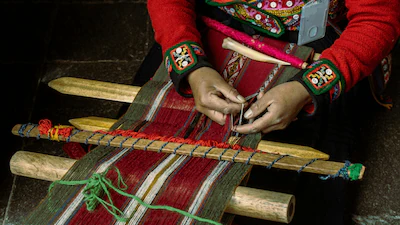 |
| The future of Indian textiles will depend not only on protecting centuries-old techniques but also on ensuring the people behind them can build viable businesses. (Image: Canva) |
At Bharat Tex 2026, three artisans from Assam, Odisha and Andhra Pradesh revealed a truth India often overlooks: the country’s greatest wealth is not just in technology or startups, but in generations of extraordinary craftsmanship waiting to be recognised.
The conversation around India’s future is often dominated by artificial intelligence, semiconductors and manufacturing. Yet, tucked away in villages and small towns across the country are skills that have quietly survived for centuries—passed down not through textbooks but through families, patience and practice.
At Bharat Tex 2026, amid cutting-edge textile innovations and discussions about global supply chains, some of the most compelling stories came not from machines but from the artisans whose hands continue to preserve India’s living textile traditions.
An Eri silk weaver from Assam. A Tussar silk artisan from Odisha. A Kalamkari artist from Andhra Pradesh.
Their crafts are different. Their journeys are different. But together, they tell a larger story about India’s textile heritage—one where talent was never the problem. Opportunity was.
A Little Girl Who Secretly Stole A Silk Cocoon
For Deepika Kakati of Assam, weaving was never a profession she discovered. It was the language she grew up speaking.
She belongs to a family where reeling silk from cocoons, weaving yarn and creating textiles were part of everyday life. As a child eager to learn, however, she was not trusted with fresh silk cocoons.
Her mother handed her only damaged cocoons and broken yarn to practise with. Fresh cocoons were valuable; a beginner’s mistake could ruin them.
However, one day, while her mother was away, Deepika quietly picked up a fresh silk cocoon and began reeling it herself. When her mother returned and saw the perfectly reeled silk thread, she asked who had done it.
“I did," Deepika admitted. That was the day her mother realised the child had mastered the first step of an art that would define her life.
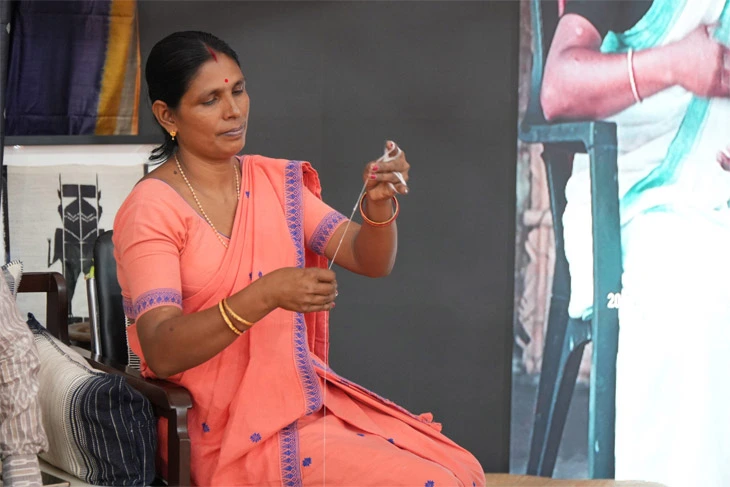 |
| Deepika Kakati at Bharat Tex 2026. |
But life had other plans.
After marriage, her parents gifted her a handloom—a treasured possession for any weaver. Then came the Brahmaputra floods.
The floods swept away her home, her belongings and the loom she cherished. Left with nothing, she began working as a daily wage artisan, producing textiles for others while earning barely enough to survive.
Like countless artisans across India, she possessed exceptional skills but had little access to the people who ultimately bought her creations. Middlemen controlled the market, dictated prices and absorbed most of the profits.
Everything changed when she received training not just in weaving, but in understanding customers, branding and running a business through Antaran, an initiative supported by Tata Trusts.
Today, Deepika owns three looms, employs and trains other artisans, and connects directly with customers through social media, including Instagram.
Her story underlines a simple truth: artisans rarely need someone to teach them their craft. More often, they need access to markets that recognise its value.
The Town That Creates Tussar Silk—But Rarely Gets The Credit
Hundreds of kilometres away in Odisha’s Gopalpur, another story unfolds.
Pramod Kumar Sur belongs to a family that has woven textiles for generations. His hometown is renowned for producing Tussar silk fabrics, yet the recognition often goes elsewhere.
According to Pramod, much of the Tussar fabric woven in Gopalpur is purchased cheaply by traders before being transported to other textile hubs, where additional embellishments or finishing work is carried out. By the time these fabrics reach consumers, they are frequently associated with the places where they were completed rather than where they were originally woven.
The irony is difficult to miss. The birthplace of the fabric often disappears from its story.
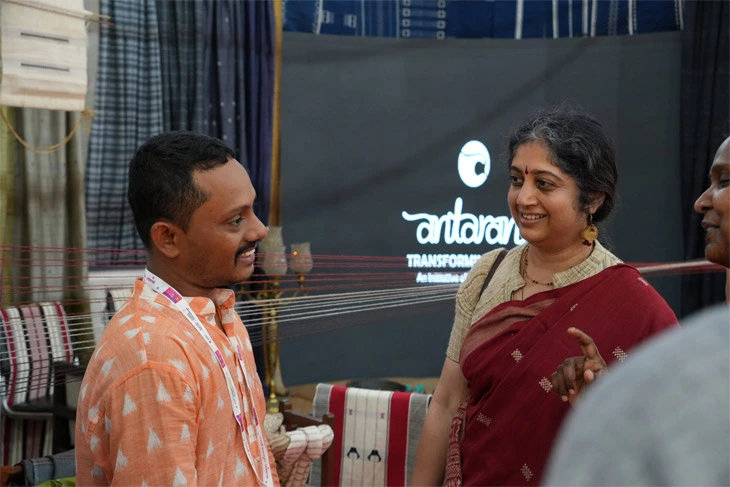 |
| Pramod Kumar Sur (left) at Bharat Tex 2026. |
Like many artisan families, Pramod’s household eventually questioned whether weaving could provide a sustainable livelihood. His father encouraged him to seek stable employment, believing the family craft no longer paid enough.
So Pramod joined a company. But something never felt right. The job offered financial security, yet it lacked the fulfilment he found in weaving—a skill that had been part of his identity long before it became his profession.
Eventually, he returned home.
Today, Pramod has built his own textile enterprise, participates in craft fairs and exhibitions, and reaches customers directly through digital platforms.
For him, the challenge facing Indian artisans has never been the absence of skill. It has been the long-standing dependence on intermediaries, a system that often leaves creators with only a fraction of the value their work generates.
The Computer Science Graduate Who Chose Kalamkari
If stereotypes were accurate, Bojja Chiranjeevi Krishna should probably be working in a software company.
Instead, the computer science graduate from Srikalahasti spends his days practising one of India’s most intricate traditional art forms—Kalamkari.
His father is a doctor. He holds a degree in computer science. Yet his calling lay elsewhere.
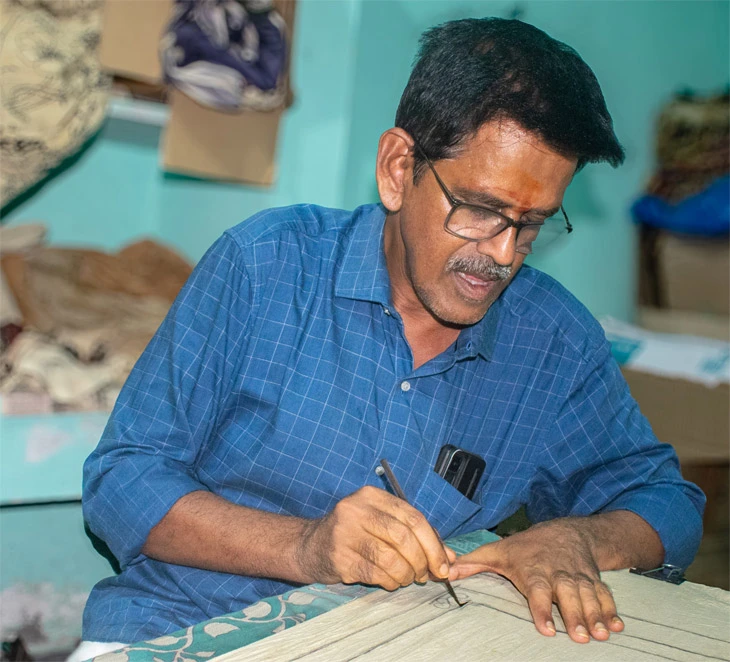 |
| Kalamkari artist Bojja Chiranjeevi Krishna. |
Listening to Krishna describe the 14 painstaking stages involved in Srikalahasti Kalamkari quickly dispels the romantic notion that traditional art is driven only by instinct.
“It is more science than people imagine," he explains.
Every stage demands precision. The artist must know exactly when to use alum, when to apply natural resins, how long to dry the fabric, when to wash it and how different natural ingredients react with one another.
Colour is chemistry. Timing is science. Drawing is only one part of a far more complex process.
Perhaps the most remarkable part of Krishna’s journey is the patience his training demanded.
For seven years, his guru did not allow him to touch the kalam—the pen used to create Kalamkari paintings.
Instead, he observed. He prepared cloth. Assisted in other stages of production. Learnt materials, processes and discipline before ever making a single line.
Only after years of observation was he entrusted with the tool itself.
Today, Krishna is experimenting with vegetable dyes while continuing to preserve the traditional methods that define Srikalahasti Kalamkari—a reminder that innovation and tradition can comfortably coexist.
India’s Forgotten Competitive Advantage
The stories of Deepika, Pramod and Krishna span different states, different crafts and different generations. Yet each points to the same conclusion: India has never lacked skilled artisans. What has often been missing are systems that allow them to earn fairly from their own work.
As Mridula Tangirala, Head of Tourism at Tata Trusts, observes, many artisans possess extraordinary craftsmanship but remain disconnected from the markets that value their creations. Supporting them with entrepreneurial skills, design understanding and direct market access can help traditional crafts become economically sustainable while preserving their cultural identity.
That shift is increasingly visible at platforms such as Bharat Tex, where artisans are no longer anonymous producers hidden behind supply chains. They are entrepreneurs, storytellers and brand owners.
More Than Heritage—An Economic Future
India’s handloom traditions are often celebrated as symbols of culture and history. But reducing them to heritage alone misses the larger picture. These crafts are living industries. They generate livelihoods, sustain rural economies and preserve knowledge that cannot be replicated by machines.
The future of Indian textiles will depend not only on protecting centuries-old techniques but also on ensuring the people behind them can build viable businesses.
Because skills alone do not pay the bills. Markets do.
And perhaps India’s greatest untapped resource is not one waiting to be invented in a laboratory—it is already woven into Eri silk in Assam, spun into Tussar in Odisha, and patiently painted onto Kalamkari cloth in Andhra Pradesh, waiting for the world to finally recognise the hands that created it.
This article was published on News18 on 1 August, 2026.
