Pancreatic cancer remains one of the deadliest cancers in India, with most cases detected too late for cure. A new mRNA vaccine is showing early promise in trials, but experts say its role, cost and real-world impact remain unclear.
 |
Pancreatic cancer is not among India’s most common cancers, but it is among the most lethal. It is often detected late, spreads quickly, and remains difficult to treat even with advances in oncology. That is why a new personalised mRNA vaccine —designed to train the immune system to recognise cancer — is drawing global attention.
It also hits closer home. Doctors say pancreatic cancer incidence in India has risen over time, even though overall rates remain lower than in Western countries. According to Dr Shailesh Shrikhande, Chief Executive at Tata Cancer Care Foundation, supported by Tata Trusts and a senior pancreatic gastrointestinal cancer surgeon, incidence has increased from about 2.5–3 per 100,000 two decades ago to nearly 6–7 per 100,000 today. However, this data must be interpreted with caution, as India’s cancer registry system is still evolving and may not capture the full burden, particularly outside urban centres.
What concerns doctors more than incidence is the pattern of detection. The pancreas is located deep within the abdomen, which allows tumours to grow silently without obvious early symptoms. By the time signs such as jaundice, persistent back pain, unexplained weight loss or loss of appetite appear, the disease is often already advanced.
India’s changing health profile may also be contributing to risk. The country has over 100 million people living with type 2 diabetes, a known risk factor for pancreatic cancer. Rising obesity, tobacco use, alcohol consumption and processed food diets add to this risk. Doctors also point to tropical pancreatitis — a chronic inflammatory condition seen in parts of India — which can increase the likelihood of cancer over time.
It is against this backdrop that even an early-stage vaccine study has generated attention.
What the vaccine is designed to do
The experimental vaccine uses mRNA technology — the same broad platform used in Covid-19 vaccines — but is tailored to each patient. Scientists analyse the genetic mutations in a patient’s tumour and create a customised vaccine.
These mutations produce abnormal proteins called neoantigens, which are unique to cancer cells. The vaccine helps the immune system recognise these neoantigens and attack cells that carry them. In simple terms, it does not directly kill the tumour; it teaches the body to identify and destroy cancer cells.
The approach is being tested by researchers at Memorial Sloan Kettering Cancer Center, a leading cancer hospital in New York, in collaboration with BioNTech, the German biotechnology company based in Mainz, and Genentech, the South San Francisco-based biotechnology company owned by Roche. In the phase 1 trial, patients with early-stage pancreatic cancer underwent surgery and chemotherapy — the current standard of care — and then received the vaccine to target any remaining cancer cells. Some patients also received immunotherapy to enhance the immune response.
What the early results show
The results have been widely described as promising, but they come with important limitations. The study included 16 patients. Of these, eight showed a measurable immune response, meaning their immune system reacted to the vaccine. Among these responders, long-term follow-up suggested that several remained alive years later, with figures approaching 90% survival in this subgroup.
However, experts stress that this is not directly comparable to overall pancreatic cancer survival rates, which are typically around 10–13% at five years. The study group was small, highly selected, and limited to patients whose cancer could besurgically removed.
More importantly, all patients received surgery and chemotherapy, treatments that are already known to improve survival. This makes it difficult to isolate theeffect of the vaccine itself. Larger trials are now underway to determine whether these early signals translate into meaningful clinical benefit.
Why pancreatic cancer remains so difficult to treat
 |
To give some background context, one of the most difficult to treat cancers, solid cancers in the body, is pancreatic cancer. "Worldwide, there is data that it's not easy to have long-term survival with pancreatic cancer. Having said that, conventional, well-established treatments of pancreatic cancer, which is localised, which means Stage 1, Stage 2, or Stage 3, is radical cancer surgery, even today in 2026, in the era of precision oncology and the new vaccine story surgery is the cornerstone for localised pancreatic cancer worldwide. In addition to that, in the last 8 years, we have made impressive progress with chemotherapy, in pancreatic cancer,” said Dr Shailesh Shrikhande adds.
According to him, the mRNA vaccine study has been in conversation since the past year and has been brought up again in recent news, as a “novel approach” of using a vaccine to kill a cancer. Vaccines actually don't directly kill the cancer. It enables and strengthens the body's immune system to identify cancer cells.”
Why scientists see this as an important step
“Both perspectives may emerge. Scientifically, this trial has established something of lasting importance: that pancreatic cancer, which was long considered invisible to the immune system, can be made immunologically recognisable through personalised neo-antigen vaccination,” added Dr Somnath Chattopadhyay, Consultant and Head of Department, Hepato-Pancreato-Biliary Surgery and Liver Transplant at Kokilaben Dhirubhai Ambani Hospital.
In simple terms, pancreatic cancer has long been considered “immune-resistant”, meaning it does not easily trigger an immune response. This study suggests that it may be possible to make the cancer visible to the immune system.
Why experts urge caution
“Clinically, however, significant caution is warranted. Only 16 patients were enrolled, only half responded, and the treatment applies exclusively to the minority of patients with resectable disease. Manufacturing these vaccines currently costs more than $100,000 per patient. A global Phase 2 trial is now underway, and its results will be important on the way forward and future potential. The early signals are encouraging but describing this as a definitive breakthrough is premature,” added Dr Chattopadhyay.
How the immune system plays a role
“All of us develop cancers everyday in our body. But our immune system is immune-competent. It's a good system, that the minute it discovers an abnormal behaving cell, which is potentially dangerous, it takes it out of the system automatically. This happens to all of us as we talk, as we discuss, and as we lead our lives.
However, if at some point in time this system stops functioning well, one single cell becomes a tumor and can develop into cancer. The vaccine works to enable and teach the body to identify cancer cells, which are specific to one’s body. It trains the immune system, so that the immune system is able to identify and destroy these cancer cells. In essence this is what it means to use the mRNA vaccine,” added Dr Shrikhande.
The biggest challenge: late diagnosis
“A large number of pancreatic cancers continue to be detected at an advanced stage. By the time a patient visits the clinic and the cancer is identified, they are often already at Stage 3 or Stage 4. This trend persists worldwide and is reflected in my own practice. During my 25-year association with Tata Memorial Hospital, nearly 50% of pancreatic cancer patients have presented at an advanced stage, where only palliative treatment can be offered. The word curative simply does not exist in such cases,” added Dr Shrikhande.
Palliative treatment refers to care aimed at relieving symptoms and improving quality of life, rather than curing the disease.
What this means for us
With reference to the study mentioned, it should be noted that this is a Phase 1 study. It was conducted amongst a group of 16 patients. And in 16 patients, eight patients, because of the vaccine, responded where the immune system seemed to get better. “I use the word ‘seemed’ to bring out a realistic picture of where we stand with this progress that we have seen since last year. Out of 16 patients, eight patients have a better immune system and a response, and then six patients out of these eight are the ones who have lived quite long, enabling us to jump to the figure of 90%,” added Dr Shrikhande.
“All patients were early-stage and received surgery and chemotherapy—the vaccine was an add-on. So it’s hard to say how much of the benefit is truly due to the vaccine.”
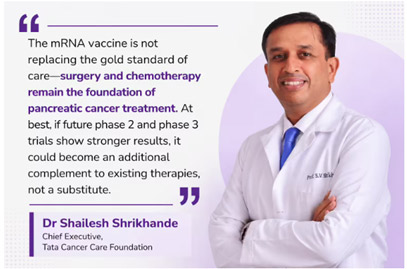
According to him, we must be careful not to jump to conclusions. “The mRNA vaccine is not replacing the gold standard of care—surgery and chemotherapy remain the foundation of pancreatic cancer treatment. At best, if future phase 2 and phase 3 trials show stronger results, it could become an additional complement to existing therapies, not a substitute,” added Dr Shrikhande.
What comes next
The next phase of clinical trials will determine whether the vaccine can deliver consistent benefits across a larger group of patients and whether it can meaningfully improve survival.
For now, the development represents an important scientific step, showing that pancreatic cancer, long considered resistant to immune-based therapies, may be more vulnerable than previously thought.
But in clinical terms, experts say, it is still too early to call it a breakthrough.
This article was published in The Times of India on 27th April, 2026.
