From abandonment to leadership
Across rural India, access to knowledge and collective enterprise is beginning to change who participates in, and leads, local economies. In Jharkhand’s Dumka district, that shift is reflected in the rise of a woman who today heads a farmer-owned company supporting thousands of families.
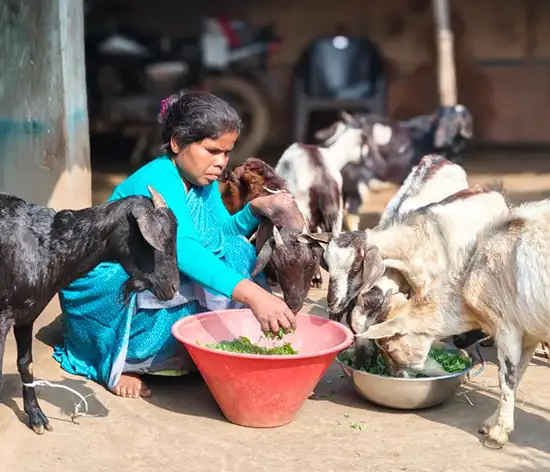
On most mornings in Tapsi village in Jharkhand’s Dumka district, farmers know exactly where to go when they face a problem — be it a sick goat, a breeding issue, or advice on selling livestock.
They go to Bahamuni Kisku.
By mid-morning, it is common to see farmers arriving outside her courtyard, sometimes with goats tethered by a rope, waiting to speak with her.
Today, the 37-year-old Bahamuni Kisku is the President of the Jagruk Mahila Farmer Producer Company in Jama block, Dumka district, Jharkhand — a women-led enterprise with 2,317 shareholders and a turnover of Rs3.51 crore in FY 2024–25. The collective now supports the livelihoods of more than 10,000 families across the region.
But the respect she commands today stands in stark contrast to the life she once lived. The transformation did not happen overnight. It began with a decision: she would not accept defeat by fate.
This too shall pass
At 23, Bahamuni returned to her parental home with a three-year-old daughter and nowhere else to go. Her husband had abandoned her without explanation. In her community, that meant more than the loss of a partner — it meant the loss of identity. She had no land, no house and no savings. Whispers followed her through the village lanes. Social invitations stopped coming.
To feed her daughter, she began working as an agricultural wage labourer. Some months she earned Rs1,500 to Rs2,000 — when work was available. In the off-season, even that meagre income disappeared. “I was not afraid of hard work,” Bahamuni recalls. “I was afraid my daughter would lose her future because of my poverty.”
For years, life remained a cycle of uncertainty.
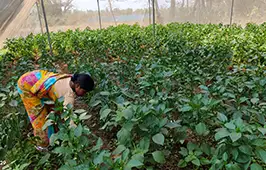 |
| Bahamuni combines crop cultivation and livestock rearing to build a more resilient source of income. |
The turning point came in 2018 when Bahamuni joined a self-help group and became part of the Lakhpati KisanTM programme of the Tata Trusts and the Collectives for Integrated Livelihood Initiatives (CInI).
At first, she attended the sessions quietly battling self-doubt. “I had never spoken in meetings before,” she says. “I didn’t know if I belonged there. Was I capable enough to practice what I was learning?” “I carried a notebook everywhere, wrote down everything,” she recalls. “Not because someone told me to. But because I felt this knowledge was utmost important to change my life.”
The programme introduced her to scientific goat rearing — a critical livelihood for many tribal families in Jharkhand. She learned about improved housing, disease prevention, vaccination schedules and low-cost nutritional supplements such as Azolla, a protein-rich aquatic plant used as livestock feed.
Turning a Backyard into a Business
Back home, she began experimenting in the only space she had — a small backyard.
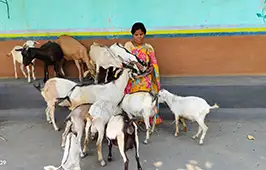 |
| For Bahamuni Kisku, goat rearing became the first step towards rebuilding her life. |
She built a raised goat shed using iron and bamboo poles and tin sheets to keep the animals dry and reduce infections. She dug a pit to cultivate Azolla for goat feed. She also followed a strict vaccination calendar, carefully recording every detail in the notebook she carried everywhere.
Slowly, the results became visible. Her goats were healthier. They gained weight faster. Mortality rates dropped. Soon neighbours began stopping by her house to look at her goats. “People asked why my goats looked different,” Bahamuni says with a smile. “I told them there was no secret. Only on-time application of science.”
Facing challenges head on
As her confidence grew, she began to notice a problem affecting farmers across the villages in her Panchayat. The traditional Black Bengal goats that households had reared for generations were gradually shrinking in size. Years of unregulated breeding had weakened the stock, reducing their market value.
Most people accepted it as fate. But Bahamuni did not.
With support through the Lakhpati KisanTM programme, she sourced four improved breeding bucks and started offering structured breeding services to farmers across nearby villages — an initiative she called her “buck induction enterprise”.
Farmers began arriving from neighbouring villages, sometimes walking long distances with their goats, hoping stronger genetics would improve the value of their herds.
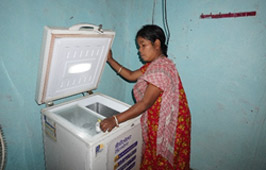 |
| A solar-powered vaccine storage chamber |
Today, more than 550 households benefit from the breeding services she introduced. Her own herd eventually grew to 34 goats. She also began aggregating goats from neighbouring villages — eight to twelve every month — and selling them collectively to secure better market prices.
Just then, another challenge emerged.
Vaccines needed to protect livestock often got spoiled due to frequent power cuts in the region. Without reliable cold storage, farmers struggled to maintain regular vaccination schedules and faced livestock loss. Instead of accepting the problem, Bahamuni looked for a solution.
Through the joint venture of her FPC (Farmer Producer Company) and CInI, she invested in a solar-powered vaccine storage chamber, ensuring vaccines remained effective even during long electricity outages. The facility soon became a shared resource for the community.
Under the guidance and assistance from the FPC’s animal husbandry personnel, Bahamuni also promoted six young individuals as Goat Service Providers for her panchayat area, who now travel across villages delivering vaccination and basic animal healthcare services to farmers who cannot travel to her place.
What began as a personal workaround gradually evolved into a small but effective livestock health network serving hundreds of households.
From Farmer to Community Leader
Her growing leadership did not go unnoticed. In 2021, Bahamuni was elected Director of the Jagruk Mahila Farmer Producer Company Limited. Two years later, she became its President. Under her leadership, the enterprise has expanded to 2,317 women shareholders, helping small farmers access quality inputs, aggregation systems and better market opportunities. Her own income has risen dramatically — from less than Rs25,000 a year during her days as a wage labourer to more than Rs3 to 4 lakh annually, today.
Beyond Income
But the most meaningful change, she says, is not financial. It is what the transformation has meant for her daughter. The child she once feared might grow up limited by poverty is now pursuing a degree in Political Science — a milestone in villages where girls’ education often ends early due to poverty. Bahamuni’s journey is also changing attitudes in her community. Families who once hesitated to send women to meetings now encourage them to attend trainings. Young girls in the village see new possibilities for their future. “The same people who once avoided speaking to me now come to me for advice,” she says.
Across rural India, women contribute significantly to agriculture yet often lack ownership of assets, access to markets or decision-making power. Bahamuni’s leadership challenges that pattern — not as an exception, but as a signal of what becomes possible when rural women gain access to knowledge, collective platforms and institutional support.
Today she leases 1.2 acres of land, manages diversified farming activities and continues expanding her livestock enterprise, while guiding thousands of farmers through the producer company. Yet she has not forgotten where her journey began. “They tried to break me,” Bahamuni says quietly. “Instead, I built a future — for myself, my daughter and for the women who now believe they can rise.”
Bahamuni’s journey is a reminder that when rural women gain the tools to lead, they do more than transform their own lives - they reshape local economies and strengthen communities.
Written by Dhanishta Tiwari from the Communications Team at Tata Trusts, with inputs from CInI - Jharkhand team.
About Jagruk Mahila Farmer Producer Company
Jagruk Mahila Farmer Producer Company Limited (JMFPCL) is a vibrant women-led community institution operating in the Jama Block of Dumka district since November 2016. Established to improve the socio-economic conditions of rural and tribal families, it has grown into a strong platform for collective action, strengthening farmer institutions and ensuring reliable input - output supply chains with doorstep services. Through continuous capacity building and transparent governance, the company has earned deep trust among its members.
In the financial year 2024-25, JMFPCL achieved a business turnover of Rs3.51 crore, reflecting strong leadership and disciplined management. More than 82% of the business was handled by the Board of Directors, demonstrating their active involvement, accountability, and commitment to creating meaningful impact for farmers. The Board members like Bahamuni Kisku are not merely decision-makers but active contributors, ensuring that strategies translate into real impact at the farmer level. Through systematic planning, market intelligence, and community engagement, JMFPCL has positioned itself as a credible and growing farmer producer company in the region.
