


Page 79 - Annual Report
P. 79
Overview
India – a country with the world’s second-largest
urban population – is home to millions of people
who migrate to cities in search of livelihood and live
in informal settlements. Today, by conservative
estimates, about 900 million people live in slums.
Urbanisation in such informal settlements is largely
unplanned, with an overarching lack of basic
services and civic amenities.
The objective of the Urban Habitat portfolio is to
promote sustainable habitats that provide
appropriate land tenure, housing and a conducive
living environment for the urban poor, to improve
their quality of life. The current interventions focus on:
(i) Improving access to land tenure, affordable
housing and liveable habitat
(ii) Building the capacity of Government
institutions to deliver basic services
(iii) Improved urban governance
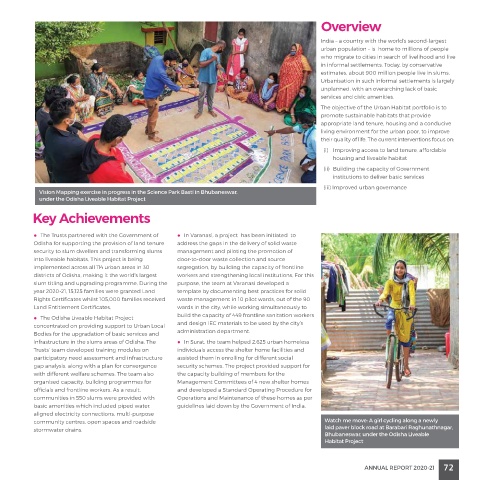
Vision Mapping exercise in progress in the Science Park Basti in Bhubaneswar,
under the Odisha Liveable Habitat Project
Key Achievements
The Trusts partnered with the Government of In Varanasi, a project has been initiated to
Odisha for supporting the provision of land tenure address the gaps in the delivery of solid waste
security to slum dwellers and transforming slums management and piloting the promotion of
into liveable habitats. This project is being door-to-door waste collection and source
implemented across all 114 urban areas in 30 segregation, by building the capacity of frontline
districts of Odisha, making it the world's largest workers and strengthening local institutions. For this
slum titling and upgrading programme. During the purpose, the team at Varanasi developed a
year 2020-21, 15,125 families were granted Land template by documenting best practices for solid
Rights Certificates whilst 105,000 families received waste management in 10 pilot wards, out of the 90
Land Entitlement Certificates. wards in the city, while working simultaneously to
The Odisha Liveable Habitat Project build the capacity of 449 frontline sanitation workers
concentrated on providing support to Urban Local and design IEC materials to be used by the city’s
Bodies for the upgradation of basic services and administration department.
infrastructure in the slums areas of Odisha. The In Surat, the team helped 2,625 urban homeless
Trusts’ team developed training modules on individuals access the shelter home facilities and
participatory need assessment and infrastructure assisted them in enrolling for different social
gap analysis, along with a plan for convergence security schemes. The project provided support for
with different welfare schemes. The team also the capacity building of members for the
organised capacity, building programmes for Management Committees of 4 new shelter homes
officials and frontline workers. As a result, and developed a Standard Operating Procedure for
communities in 550 slums were provided with Operations and Maintenance of these homes as per
basic amenities which included piped water, guidelines laid down by the Government of India.
aligned electricity connections, multi-purpose
community centres, open spaces and roadside Watch me move: A girl cycling along a newly
stormwater drains. laid paver block road at Barabari Raghunathnagar,
Bhubaneswar, under the Odisha Liveable
Habitat Project
00
ANNUAL REPORT 2020-21 72

