


Page 67 - Annual Report
P. 67
The Trusts support sports as a powerful accelerator
                                                                                                            for meaningful development, with a focus on young
                                                                                                            children and youth, especially the underprivileged
                                                                                                            and under-served sections from the rural and tribal
                                                                                                            regions of the country, given that historically, these
                                                                                                            regions have produced the best athletes who have
                                                                                                            succeeded through sheer determination.
                                                                                                            The Trusts’ strategy is based on the ‘Sports
                                                                                                            Development Pyramid’, which aims to lay a strong
                                                                                                            foundation for enjoyable physical education and
                                                                                                            sports through in-school and grassroots level
                                                                                                            programmes,  before building on these
                                                                                                            fundamental blocks to identify talented players and
                                                                                                            coaches, and provide competitive training
                                                                                                            opportunities that lead them to various careers in
                                                                                                            sports as players, officials, administrators, etc.
                                                                                                            Further, given that partnerships make programmes
                                                                                                            stronger and more sustainable, the Trusts identify
                                                                                                            local partners with strong outreach capabilities,
                                                                                                            such as local clubs, coaches, communities and
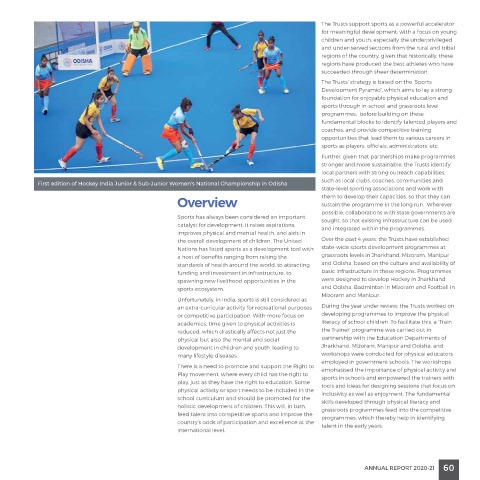
                       First edition of Hockey India Junior & Sub-Junior Women's National Championship in Odisha
                                                                                                            state-level sporting associations and work with
                                                                 Overview                                   them to develop their capacities, so that they can
                                                                                                            sustain the programme in the long run.  Wherever
                                                                                                            possible, collaborations with state governments are
                                                                 Sports has always been considered an important   sought, so that existing infrastructure can be used
                                                                 catalyst for development; it raises aspirations,   and integrated within the programmes.
                                                                 improves physical and mental health, and aids in
                                                                 the overall development of children. The United   Over the past 4 years, the Trusts have established
                                                                 Nations has listed sports as a development tool with   state-wide sports development programmes at
                                                                 a host of benefits ranging from raising the   grassroots levels in Jharkhand, Mizoram, Manipur
                                                                 standards of health around the world, to attracting   and Odisha, based on the culture and availability of
                                                                 funding and investment in infrastructure, to   basic infrastructure in these regions. Programmes
                                                                 spawning new livelihood opportunities in the  were designed to develop Hockey in Jharkhand
                                                                 sports ecosystem.                          and Odisha, Badminton in Mizoram and Football in
                                                                                                            Mizoram and Manipur.
                                                                 Unfortunately, in India, sports is still considered as
                                                                 an extra-curricular activity for recreational purposes   During the year under review, the Trusts worked on
                                                                 or competitive participation. With more focus on   developing programmes to improve the physical
                                                                 academics, time given to physical activities is   literacy of school children. To facilitate this, a ‘Train
                                                                 reduced, which drastically affects not just the   the Trainer’ programme was carried out in
                                                                 physical but also the mental and social    partnership with the Education Departments of
                                                                 development in children and youth, leading to   Jharkhand, Mizoram, Manipur and Odisha, and
                                                                 many lifestyle diseases.                   workshops were conducted for physical educators
                                                                                                            employed in government schools. The workshops
                                                                 There is a need to promote and support the Right to   emphasised the importance of physical activity and
                                                                 Play movement, where every child has the right to   sports in schools and empowered the trainers with
                                                                 play, just as they have the right to education. Some   tools and ideas for designing sessions that focus on
                                                                 physical activity or sport needs to be included in the   inclusivity as well as enjoyment. The fundamental
                                                                 school curriculum and should be promoted for the   skills developed through physical literacy and
                                                                 holistic development of children. This will, in turn,   grassroots programmes feed into the competitive
                                                                 feed talent into competitive sports and improve the   programmes, which thereby help in identifying
                                                                 country’s odds of participation and excellence at the  talent in the early years.
                                                                 international level.


                                                                                                                                               00
                                                                                                                         ANNUAL REPORT 2020-21 60

