


Page 49 - Tata-Trusts-Annual-Report-2022-23
P. 49
The Future is not fallow for
                             Self Help Groups in Leh                                                                           EMPOWERMENT


                                             Diversifying crops helped diversify incomes


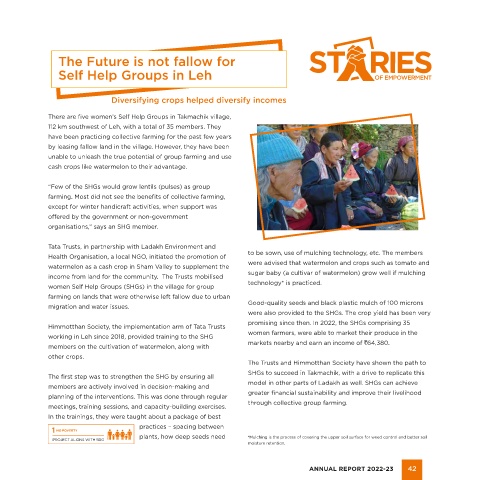
                          There are five women’s Self Help Groups in Takmachik village,
                          112 km southwest of Leh, with a total of 35 members. They
                          have been practicing collective farming for the past few years
                          by leasing fallow land in the village. However, they have been
                          unable to unleash the true potential of group farming and use
                          cash crops like watermelon to their advantage.


                          “Few of the SHGs would grow lentils (pulses) as group
                          farming. Most did not see the benefits of collective farming,
                          except for winter handicraft activities, when support was
                          o ered by the government or non-government
                          organisations,” says an SHG member.


                          Tata Trusts, in partnership with Ladakh Environment and
                                                                                      to be sown, use of mulching technology, etc. The members
                          Health Organisation, a local NGO, initiated the promotion of
                                                                                      were advised that watermelon and crops such as tomato and
                          watermelon as a cash crop in Sham Valley to supplement the
                                                                                      sugar baby (a cultivar of watermelon) grow well if mulching
                          income from land for the community.  The Trusts mobilised
                                                                                      technology* is practiced.
                          women Self Help Groups (SHGs) in the village for group
                          farming on lands that were otherwise left fallow due to urban
                                                                                      Good-quality seeds and black plastic mulch of 100 microns
                          migration and water issues.
                                                                                      were also provided to the SHGs. The crop yield has been very
                                                                                      promising since then. In 2022, the SHGs comprising 35
                          Himmotthan Society, the implementation arm of Tata Trusts
                                                                                      women farmers, were able to market their produce in the
                          working in Leh since 2018, provided training to the SHG
                                                                                      markets nearby and earn an income of `64,380.
                          members on the cultivation of watermelon, along with
                          other crops.
                                                                                      The Trusts and Himmotthan Society have shown the path to
                                                                                      SHGs to succeed in Takmachik, with a drive to replicate this
                          The first step was to strengthen the SHG by ensuring all
                                                                                      model in other parts of Ladakh as well. SHGs can achieve
                          members are actively involved in decision-making and
                                                                                      greater financial sustainability and improve their livelihood
                          planning of the interventions. This was done through regular
                                                                                      through collective group farming.
                          meetings, training sessions, and capacity-building exercises.
                          In the trainings, they were taught about a package of best
                                                      practices – spacing between
                                                      plants, how deep seeds need     *Mulching is the process of covering the upper soil surface for weed control and better soil
                                                                                      moisture retention.


                                                                                                         ANNUAL REPORT 2022-23        42

