














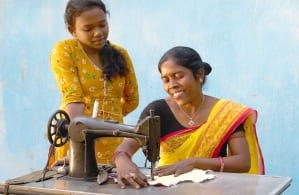
Through MAATI - The Crafts School, the Tata Trusts are helping women artisans in Bihar transform inherited craft knowledge into sustainable livelihood opportunities.
In the Mithila region of Bihar, Mithila art has been part of daily life for generations. Across villages, mothers teach daughters the motifs, colours and
stories that shape the tradition. But earning a stable income from it has always been far more difficult than learning it. The Mithila Art & Artisan
Transformation Initiative (MAATI), founded by Kadam India and supported by the Tata Trusts, works with artisan communities through craft training,
design innovation and market access.
The initiative aims to impact 3,500 Mithila artists and their family members in Madhubani and Darbhanga over three years. Average annual income of artisans is expected to rise from a baseline of ₹36,000 to ₹1,00,000 per artisan. By the end of the programme, 100 artisan enterprises will be developed, with average annual revenue of ₹14 lakh per enterprise by the final year, varying with the entrepreneurial ability of the artisan entrepreneur.
For many artisans, this transformation begins by recognising that a skill passed down through generations can become the foundation for an independent livelihood.
Seeing Their Craft Through New Eyes
Ram Dulari Devi (50) has spent more than twenty years practising Madhubani. Like many artisans, she learnt it at home and carried it forward through the years. What began as a traditional practice within her home has gradually become an important source of livelihood, helping her earn an average monthly income of ₹8,000–9,000 through her artwork. With MAATI, she has slowly began exploring new ways of working with the craft, experimenting with different products, compositions, and ideas while staying deeply connected to the traditions she grew up with. Every new experience has become a small step towards building confidence in her own creative voice.
One such opportunity came through Colours of MAATI, a showcase in Bengaluru where Ram Dulari Devi, along with fellow artisans Rubi Devi, Priyanjali Kumari and Anjali Kumari, interacted directly with potential buyers. While the objective was to create a direct channel between artisans and customers, what each of them took home was harder to pack, but far more valuable than anything they carried there.
For Ram Dulari Devi, the showcase brought a different perspective to her craft. She found herself teaching visitors how to draw traditional motifs during workshops. Many participants assumed the patterns would be easy to recreate. As they picked up the brush, they discovered the patience, precision and control the craft demanded. Years of practice had made the craft feel familiar to her. Watching others attempt made her appreciate her own skills.
The interactions at the showcase, also gave her the confidence to speak directly with customers and walk them through with the detailed process that goes behind in creating each piece. When Ram Dulari made her first direct sale, she was gleaming with pride, “Hum apna ek saree khudse beche (I sold my own saree (artwork) myself),” she said.
— Ram Dulari Devi
— Rubi Devi
Discovering New Markets
Understanding where a traditional skill can create new opportunities is another
important step in the journey. For Rubi Devi (34), the showcase offered a different
kind of revelation.
She visited local stores during their stay in Bengaluru, and recalls, “…what was being sold as Madhubani painted sarees, was actually all printed.”
While at the showcase, the visitors were curious about the meanings behind different motifs and the process of creating each piece by hand. Their questions reflected a growing appreciation for authentic craftsmanship. The contrast sharpened her understanding of how handmade products are perceived and the role artisans can play in helping people recognise their value.
Imagining a Bigger Future
For the younger artisans, Priyanjali Kumari (18) and Anjali Kumari (20), the showcase event at Bengaluru opened up their minds to a wider future.
Both Priyanjali and Anjali are budding artisans and have begun building their own identity under the name Tripatra Art and Anjali Arts, respectively. At the close of the showcase, Anjali made her first sale: A linen saree, painted entirely by herself.
“The more we open ourselves to new ideas, the stronger our art becomes.”
— Anjali Kumari
“Interactions with the visitors reinforced my belief that tradition can continue to evolve while remaining rooted in its origins.”
— Priyanjali Kumari
For most, the journey begins with an exhibition or a first sale. What follows is the confidence to
imagine themselves not just as artisans, but as entrepreneurs. These four women are part of a
larger movement that is preserving Madhubani as a living tradition while helping artisans build
contemporary brands, reach new markets and create sustainable livelihoods on their own terms.
