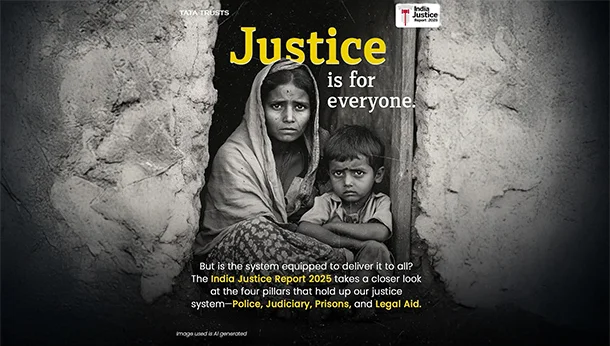
The India Justice Report (IJR) 2025 is India’s first and only comprehensive quantitative index which uses government data to rank the capacity of ‘pillars’ of the formal justice system.
First published in 2019, with the support of Tata Trusts, it continues to track improvements and persisting deficits in each state’s structural and financial capacity to deliver justice based on quantitative measurements of budgets, human resources, infrastructure, workload, and diversity across police, judiciary, prisons, legal aid, and Human Rights Commissions for all 36 states and UTs.
The IJR is a collaborative effort undertaken in partnership with DAKSH, Commonwealth Human Rights Initiative, Common Cause, Centre for Social Justice, Vidhi Centre for Legal Policy and TISS-Prayas.
The India Justice Report, first published in 2019 with the support of the Tata Trusts, is a first-of-its-kind national periodic reporting that ranks states' capacity to deliver justice.
Through the filters of human resources, infrastructure, budgets, workload and diversity, it assesses the capacity of four core pillars of the justice system to deliver to mandate: police, prisons, judiciary, legal aid and Human Rights Commissions. Importantly, by comparing data over five years, the IJR assesses efforts governments make year on year to improve the administration of justice. This trend analysis helps discern each state’s intention to improve the delivery of justice and match it with the needs on the ground. To its assessment of police, prisons, legal aid, judiciary, and state human rights commissions, this edition of the IJR draws attention to forensics, mediation, and disabilities.
By bringing previously siloed data all in one place, the IJR provides policymakers with an easy but comprehensive tool. On the one hand, having the data all in one place provides a jumping-off point on which to base holistic policy frameworks while, on the other hand, the itemisation of the data into budgets, human resources, infrastructure, workload and diversity helps to pinpoint low-hanging fruit, which, if tackled early on, can set up a chain reaction reformative of the whole.
The findings of the report are important for donors, civil society and the business community as well because it provides important stakeholders within influential circles with objective data around which to fashion their own recommendations. It allows for participatory dialogues between governments and active citizens of disparate ideologies to be underpinned by objective facts rather than premised in opinion. This enhances the chances for reforms through consensus building.
"As India moves forward into a hundred years of being a democratic, rule of law nation, the promise of rule of law and equal rights will remain hollow unless underwritten by a reformed justice system. Reform is not optional. It is urgent. A well-resourced responsive justice system is a constitutional imperative that must be experienced as an everyday reality available to every citizen."
— Ms Maja Daruwala,
Chief Editor, India Justice Report
Key Highlights
Police
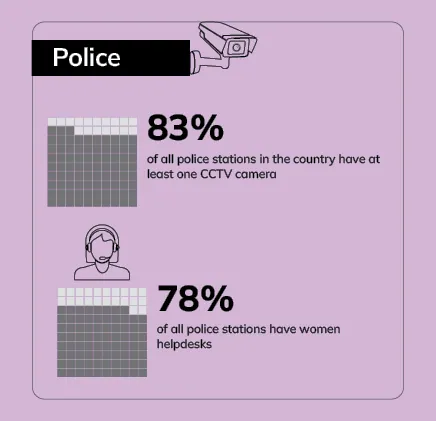
India’s policing landscape continues to show promising developments. Over the past five years, urban police stations have increased by 4 per cent, expanding access to law enforcement in rapidly growing cities. Encouragingly, 83 per cent of police stations now have dedicated women helpdesks, enhancing support and responsiveness for women in distress. Progressive measures such as the Supreme Court’s mandate for CCTV installation in police stations reflect an ongoing commitment to transparency and accountability. While implementation challenges remain, these steps collectively signal a strong move towards a more inclusive, citizen-centred, and modern policing system.
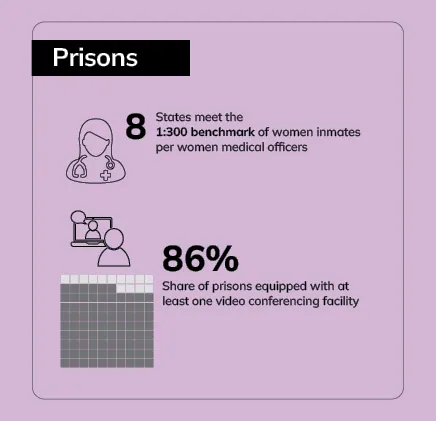
India’s prison system is witnessing steady, reform-oriented efforts. Many states have adopted the Model Prison Manual 2016, and recent legal reforms such as the Model Prison and Correctional Services Act, 2023, reflect a renewed vision for rehabilitation. Importantly, eight states now meet the benchmark of a one woman medical officer per 300 women inmates, supporting better gender-sensitive care. Additionally, 86 per cent of prisons are now equipped with video conferencing facilities, enabling faster court access and reducing logistical burdens. These developments signal a constructive shift towards safer, more accountable, and reformative correctional spaces.
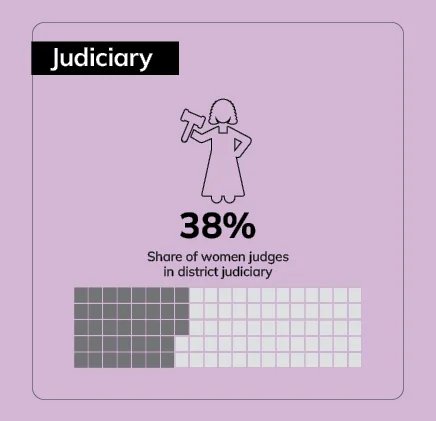
The proportion of women judges in subordinate courts has improved in nearly all states, while their presence in legal aid structures as panel lawyers and paralegal volunteers continues to expand. Although recording a drop from IJR 3, Sikkim (65% to 48%) and Meghalaya (74% to 61%) have consistently registered a high share of women judges. In 2025, at the high court level, Sikkim and Telangana had the highest share of women judges at 33%.
India’s legal aid system is evolving with stronger outreach and inclusivity. Over 15.5 lakh beneficiaries were reached in 2023–24, aided by increased budgets and targeted initiatives like Legal Aid Defence Counsels, jail clinics, and online access platforms. Gender diversity has also improved, with women making up 28% of panel lawyers and 42% of paralegal volunteers. States like Karnataka and Uttarakhand exemplify how focused investment and stable human resources can significantly improve access to justice.
Sikkim retains its 1st rank among small states and is the only one to meet the 33% women judges benchmark in High Courts. All small states register 1 in every 3 district court judges; Goa (70%) and Meghalaya (61%) lead. All small states have 80%+ police stations with at least one CCTV.
Tamil Nadu leads in prison reforms, retained its top position in prisons, with increased budget allocation and 100% utilization. With just 22 inmates per officer, it has the best officer workload among all large states. Judiciary continued to perform well, reducing vacancies by half in the High Court and increasing its per capita spend.
Maharashtra climbs to 10th place overall and 5th in police, boosted by higher spend and better CCTV coverage. It has no court hall shortfall and maintains low judicial vacancies in district courts.
Chhattisgarh records the highest rise in police training spend and 100% case clearance rates at High Court and district levels. Every police station has a women’s help desk.
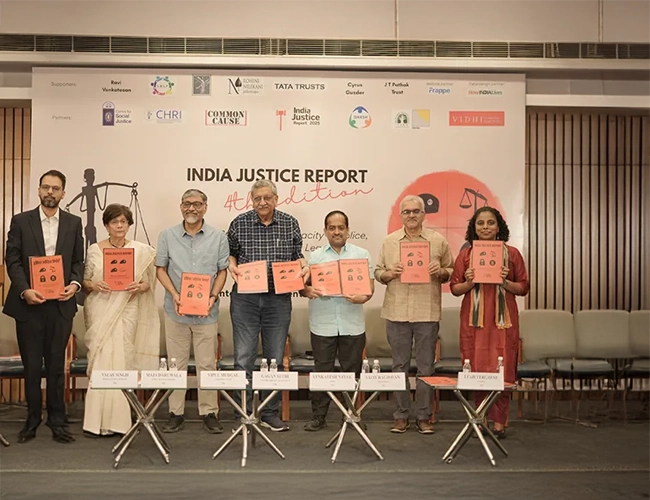
At the launch of the India Justice Report on 15 April, 2025, from left to right: Valay Singh, Lead – India Justice Report; Maja Daruwalla, Chief Editor – India Justice Report; Dr Vipul Mudgal, Director – Common Cause; Gagan Sethi, Co-founder – Centre for Social Justice; Venkatesh Nayak, Director – CHRI; Prof Vijay Raghavan, TISS-Prayas; and Leah Verghese, Research Manager – Daksh
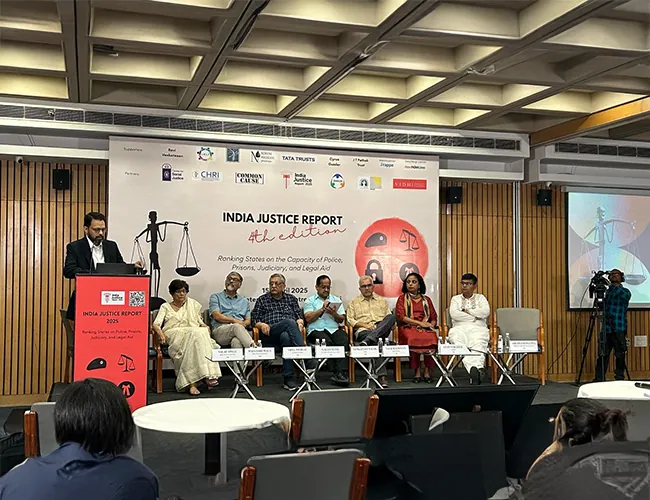
At the launch of the India Justice Report on 15 April, 2025, from left to right: Valay Singh, Lead – India Justice Report; Maja Daruwalla, Chief Editor – India Justice Report; Dr Vipul Mudgal, Director – Common Cause; Gagan Sethi, Co-founder – Centre for Social Justice; Venkatesh Nayak, Director – CHRI; Prof Vijay Raghavan, TISS-Prayas; and Leah Verghese, Research Manager – Daksh; Dr Arghya Sengupta, Founder – Vidhi Centre for Legal Policy
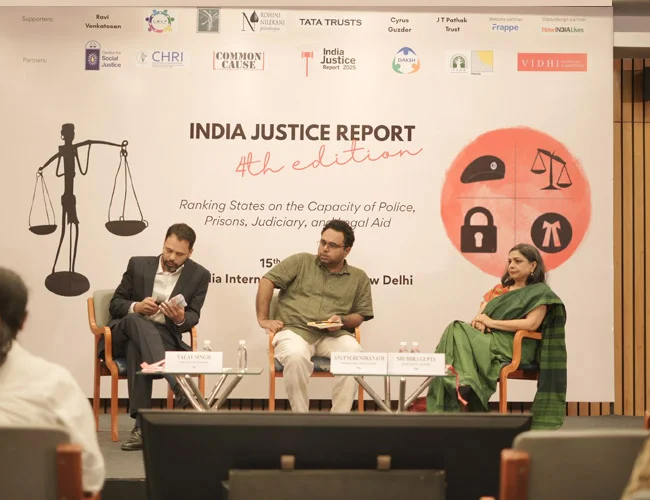
Shubhra Gupta (Film Critic & Author) and Anup Surendranath (Professor of Law and Executive Director, The Square Circle Clinic, NALSAR University of Law, Hyderabad) in conversation on justice and pop culture. Moderated by Valay Singh (Lead – India Justice Report).
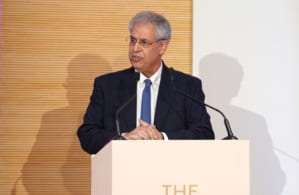
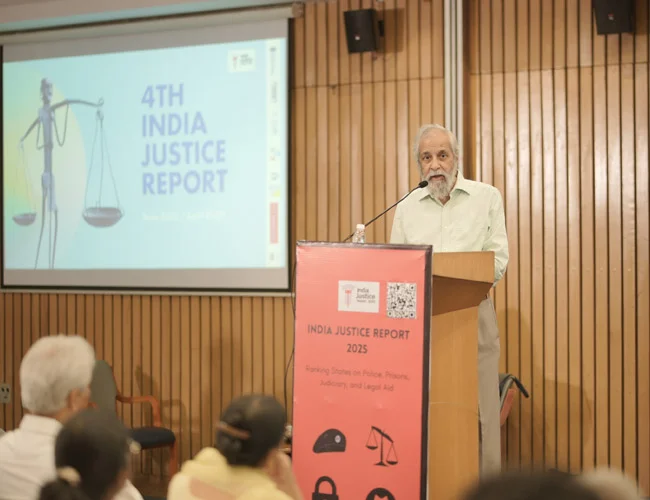
Delivering the keynote at the India Justice Report 2025 launch, former Supreme Court judge Justice Madan B. Lokur underscored the widening gap in judicial capacity.
From Social Media
What Does Justice Look Like in India Today?
The India Justice Report 2025 brings together five years of data across four pillars—Police, Judiciary, Prisons, and Legal Aid—to offer a clear, comparative picture of where each state stands.
The report highlights where states stand and what more can be done to ensure equal opportunity and meaningful representation. Many states and union territories are yet to meet their benchmarks for women’s representation in the police force. Most women in policing remain in entry-level roles, with very few making it to senior leadership positions. The pace of change is slow—but the path forward is clear.
Through its support of the India Justice Report, the Trusts affirm their belief that data-backed insights can be powerful tools for driving informed action towards a more inclusive justice system.
Released recently, the India Justice Report (IJR) was initiated by Tata Trusts, with the first-ever ranking published in 2019. In its fourth edition, the report shines a light on the capacity and performance of the formal justice system across states.
Explore the key findings and the way forward in the India Justice Report 2025
In less than a fortnight since the launch of the fourth edition of the IJR, it has garnered widespread media coverage across various platforms. Explore some of the top media stories here.
The India Justice Report 2025 ranks Indian states across four pillars and three themes. Click here to read more.
Quick Links
India Justice Report 2025: National Factsheet | English, Hindi
Tata Trusts video
This website uses cookies
We use cookies to improve your browsing experience. For more information, please refer to our Privacy Policy.