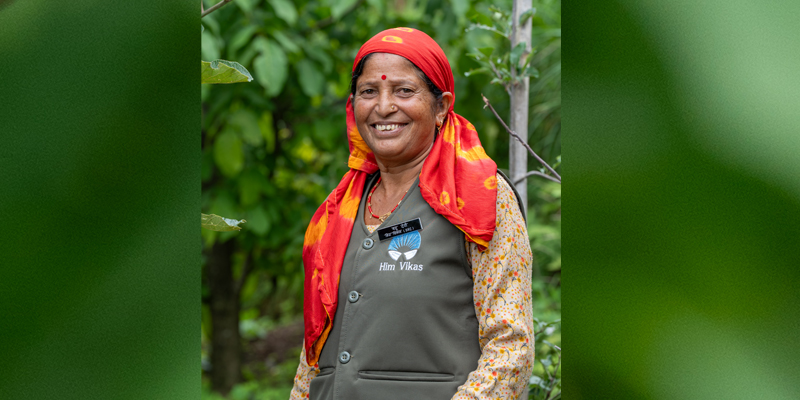
Women at the Heart of Regenerative Tourism
Discover how the Tata Trusts’ community-led tourism initiative is empowering rural women, reshaping travel, and protecting fragile ecosystems
Changing climate patterns, shrinking forests, and economic uncertainty have made life precarious for families who depend on nature for their livelihoods. Yet in the tenuous but breath-taking mountain landscapes of India, a story of resilience and prosperity is unfolding.
The Journey to Prosperity: Women at the Heart of Change
In the hills of Uttarakhand, tourism has grown beyond a means of livelihood—it has become a powerful tool for empowering local communities, preserving cultural traditions, and protecting the environment. Here, women are leading a grassroots eco-tourism movement—welcoming travellers into their homestays, introducing them to local culinary, guiding treks across ancestral trails and showcasing heritage that has been passed down for generations.
For women like Basu Devi, Laxmi Devi, Rajeshwari Devi, and Sulochana Devi, what began as a search for additional income— supported through training under the Tata Trusts’ Community Based Tourism project in association with MakeMyTrip Foundation—became something far greater. “They are no longer just hosts or guides; they are co-custodians of the fragile mountain ecosystems, finding in the process not only livelihoods but also agency, resilience and pride.” shares Rajendra Koshyari, Coordinator – Agriculture and Agri-Allied, Himmotthan Society (an organisation supported by the Tata Trusts). Himmotthan Society works with rural mountain communities to build and support sustainable interventions that enhance livelihoods, education, WaSH, and other key areas, in Uttarakhand, Himachal Pradesh and Ladakh.
From Hesitation to Confidence: The Leap of Faith by Basu Devi and Laxmi Devi
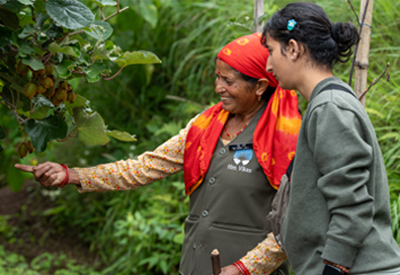 |
| Basu Devi guides visitors along the forest trails |
For 57-year-old Basu Devi of Chureddhar village, life once meant farming, rearing cattle and running her household. Uneducated and shy, she never imagined she would one day interact with strangers, let alone guide them through her forests.
When she joined a community guide training in 2022 as part of the Community Based Tourism project, self-doubt weighed heavily. “I was scared…I couldn’t even write my name, and we were expected to learn English words for guiding the guests,” she recalls. Yet step-by-step, with training and support from the project team, her confidence grew.
Today, Basu confidently leads visitors along forest trails, narrating stories of Garhwali culture, traditions and village life. The income she earns supports her household and gives her independence. “Now when I go to the market, I buy things I like with my own money,” she beams with pride. “And the best part? I get to meet people from all over India, while staying in my own village.”
Basu’s journey mirrors Laxmi’s—both have turned uncertainty into opportunity.
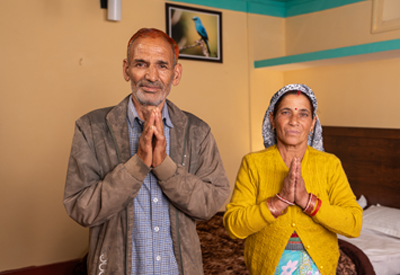 |
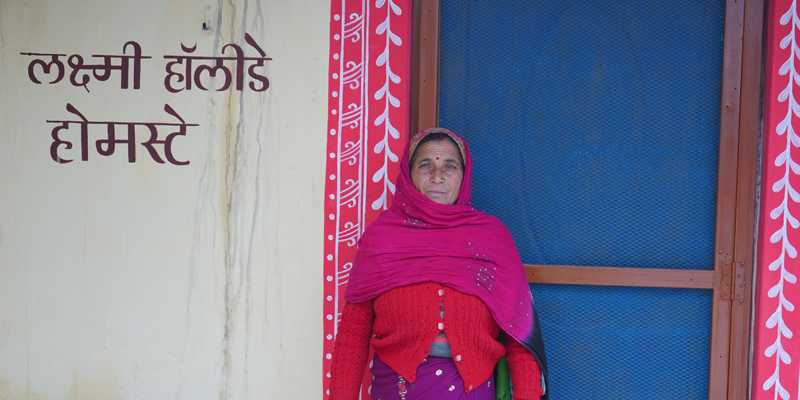
| Laxmi Devi and her husband converted spare rooms to a homestay |
Laxmi Devi of Jadipani village converted unused rooms of her home into a thriving homestay. Through training in hospitality, food presentation and guest management, Laxmi gained the skills to welcome visitors. “Initially, no one came. But gradually, guests arrived—trekkers, families, school groups,” shares Laxmi. “Now, a few guests come every month. Their payments, have helped us paint our house, repair the cowshed and covered our household expenses. Some guests have even become friends, calling to check on the family long after their stay,” adds Laxmi.
Resilience in the Face of Adversity: The Stories of Rajeshwari Devi and Sulochana Devi
 |
| Rajeshwari, owner of the Vishnu Homestay |
While Basu and Laxmi stepped into new roles with hesitation, for others like Rajeshwari and Sulochana, eco-tourism became a lifeline in the face of hardship.
In Chopdiyal village, Rajeshwari Devi’s life changed when her husband lost his leg in an accident. The hardship was daunting, but she refused to let it define their future. She and her husband seized the opportunity being offered by the project. “Launching a homestay felt risky, we didn’t know how to host guests,” recalls Rajeshwari. “But with the training, we learned and set up Vishnu Homestay in June 2023. Now the income supports our children’s education,” she shares, beaming with pride.
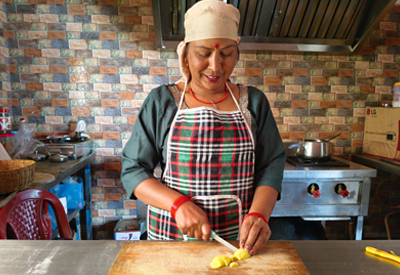 |
| Sulochana Devi, chef at the Nathuli café |
For Sulochana Devi in Jadipani, eco-tourism became her pathway to empowerment. Trained as a community guide under the project in 2022, she began leading visitors on village and forest tours, gradually overcoming her initial hesitation. In 2024, she got an unexpected opportunity: a job at Nathuli Café, a community-run tourist space. Her earnings now fund her elder son’s hotel management course, while saving for her younger child’s education. “Every day I learn something new, and guests love our food and the view,” she says, smiling.
These women exemplify how grassroots training can catalyse local leadership in eco-tourism.
The Bigger Picture: Linking Communities and Conservation
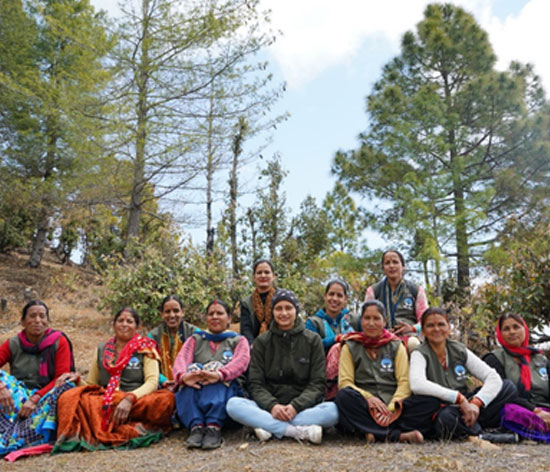
Together, these individual journeys form part of a larger transformation. With support from the Tata Trusts and MakeMyTrip Foundation and implemented by Himmotthan Society, the Community Based Tourism project has crafted authentic experiences for the tourists by mobilising 700 women from self-help groups to run homestays, guide trails, manage cafés, and curate cultural experiences.
“As eco-tourism in India grows rapidly, it must evolve into a movement that empowers women and youth, revitalises local economies, and offers travellers authentic cultural experiences. At the Tata Trusts, this is regenerative tourism in action—travel that heals landscapes, honours heritage, and transforms lives. Our approach goes beyond skill development and income generation through homestays, cafés, and guiding services; it nurtures a deep sense of custodianship for destinations.” emphasises Mridula Tangirala, Head-Tourism, Tata Trusts.
The success of this initiative is not measured in footfall or revenue alone, but in empathy, empowerment and equity. These women show that community-led tourism can protect heritage, conserve fragile ecosystems and strengthen livelihoods—proving that when tourism regenerates what it touches, it uplifts nature, culture and people alike.
Written by Dhanishta Tiwari from the Communications Team at Tata Trusts, with inputs from Nitesh Ramola from the Community Based Tourism project at Himmotthan Society.
Know about the project: Tata Trusts’ Community Based Tourism (CBT) initiative in Uttarakhand is supported by Make My Trip Foundation (MMTF). The project has been implemented in three clusters named Jadipani cluster, Tehri Garhwal and Makkumath and Ransi clusters, Rudraprayag, Uttarakhand. The project was initiated in November 2021, aiming to create a replicable, scalable and sustainable tourism business model in the rural settings of Uttarakhand, offering authentic cultural, natural and architectural heritage experiences as experiential tourism products, with complete management and ownership of the local communities and their institutions.
Explore topics
Livelihood