How business houses are reviving dying arts, and empowering local artisans to sell their wares & connect with consumers
 |
| Stitched with Survival: Corporate Giants and IoT Tech Step In to Save India’s Fading Ikat Heritage |
Binod Meher says he may well be the last generation from his family to be involved in ikat—a highly labour-intensive and time-consuming textile art, where yarn is dyed before weaving to create intricate, blurred patterns. The entire process can take three days to three months for a standard piece, while complex ones like a six-yard Bomkai ikat saree can take up to eight months, says the second-generation ikat weaver from Sonepur in Odisha.
With no bulk orders from buyers or retailers for months, Meher says there’s no guarantee of work in the future. “Most people today don’t find value in original craftsmanship; they say it’s expensive. We also find ourselves bogged down by new-age brands that are introducing machine-made versions in innovative designs and patterns,” he laments.
But help is at hand. To support people like Meher and co-create value in their crafts, the social arms of corporate giants such as Reliance Retail, Tata Group, Aditya Birla Group are helping artisans to sell their crafts and connect with the right consumer base.
Providing a platform
In a press statement, Isha Ambani, executive director, Reliance Retail Ventures, said that they saw a great opportunity for the artisans of our country in co-creating and curating handcrafted Indian products for the world. “Reliance Retail and Reliance Foundation have also aligned to identify core epicentres for the various indigenous crafts and will set up RiSE centres, a robust network of skill development centres, to ensure reach at grassroots level and to contribute in sustaining artisan communities and art forms,” she added.
Craftsmen must be looked at as partners and not vendors, adds Manish Saksena, business lead, Aadyam Handwoven, a social enterprise of the Aditya Birla Group. “Vendors are driven by volume, better margins, and many other commercial aspects. But artists value co-creation and collaboration,” he says.
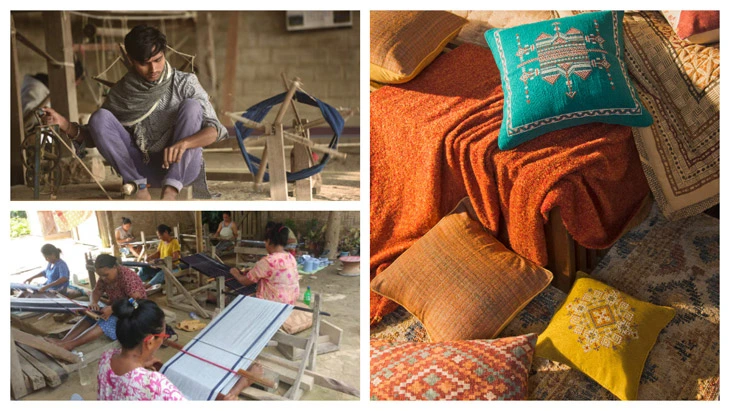
Aadyam Handwoven has been working with skilled weavers like Vankar in Kachchh, who are descendants of the Meghwal Maru community of Rajasthan. They preserve the intricate ‘extra weft’ technique, akin to embroidery, and their work is displayed through a wide range of home decor products such as cushion covers, table runners, bedspreads, throws, table settings and rugs, among others.
Aadyam Handwoven has stores in Delhi, Mumbai, Hyderabad and Bengaluru, and in global markets such as Europe and the UK.
For brands like Fabindia, which has a longstanding tradition of offering handcrafted products in natural materials, the aim has been to sensitise people to the rich diversity in India’s craft heritage. Over the years, the brand has been working with a myriad of indigenous materials from different parts of India like cotton, flax, linen, tussar and mulberry in its apparel line; natural wood, bamboo, reeds, metal, glass and ceramic in furniture and hard goods. Naturally dyed textiles in dabu, ajrakh and kalamkari, classic kurtas, handcrafted dupattas, handwoven sarees, bandhgala jackets, Rajasthani juttis and Kolhapuri chappals are a few examples of their artisanal offerings.
“Post pandemic, we have seen a shift to conscious living and mindful consumption. We notice a growing appetite for natural and artisanal products in smaller cities in addition to the metros, which have always been thriving markets for handcrafted products. Our products showcase a lifestyle that celebrates sustainable living,” says Sumit Arora, president, apparel, Fabindia.
While artisans across diverse geographies face growing pressures from mass production, automated techniques, and the influx of cheaper, machine-made goods, the impact of this is clear: many are abandoning their crafts to pursue more run-of-the-mill economic opportunities.
But organisations like Tata Trusts are reversing this trend by bridging the gap between centuries-old craftsmanship and modern market realities. As per Mridula Tangirala, head, tourism, Tata Trusts, India’s handloom sector employs 35 lakh artisans, 70% of whom are women, carrying a deeply personal and generational weaving heritage. “Weaving for them isn’t just a viable opportunity to earn income and support their families, but a deeply personal and familial legacy passed from generation to generation.
Antaran opens avenues for them to participate in India’s economic growth story,” says Tangirala.
In the financial year 2022-23, Tata Trusts disbursed Rs 867.75 million in institutional grants and direct implementation project expenses for their rural upliftment initiatives. Since 2018, Antaran, its craft-based livelihood initiative, has helped create 328 micro-enterprises that cumulatively generated Rs 500 million in revenue, and engaged 3,000 artisans. It supports traditional weavers across six lesser-known handloom clusters in four different states (Kamrup and Nalbari in Assam, Dimapur in Nagaland, Gopalpur and Maniabandha in Odisha, and Venkatgiri in Andhra Pradesh) and helps them step up as artisanal entrepreneurs.
Antaran is also collaborating with a Bengaluru-based startup Kosha to adopt IoT (Internet of Things) devices to trace the journey of each handloom product.
“In this pilot, by embedding a small device in the loom, every product’s creation is documented-ensuring authenticity, quality, and traceability,” adds Tangirala. The sensor-activated device is placed on the loom as artisans weave, tracing who has woven it and when; thus reassuring consumers of the credibility of the products. Each product gets a tamper-proof label stitched in during weaving, and a unique QR code that includes artisan information and location, making it possible to trace the products’ route from weaver to customer.
Aadyam Handwoven ensures that the craft is retained in its purest form, giving craftsmen full freedom by not taking any shortcuts. “During the pandemic, there were no product sales, so artisans were given complex products which resulted in slower output. By the end of nine months, we had lesser products in hand but more complex and gorgeous products because of the ease of working at their own pace without any pressure,” adds Saksena.
The road ahead
While the creative industry is a $30-billion industry responsible for the employment of nearly 8% of India’s working population, the sectors are self-organised and even unorganised in certain spaces, as per Rakhi Sarkar, founder of the Kolkata-based CIMA Art Gallery and chairperson of the All India Initiative on Creative Economy. “They are functioning, but barely,” she adds.
In 2017, soon after the Goods & Services Tax (GST) was brought in, work for weavers across the country started drying up due to the 5% tax imposed on cotton and yarn. “The foundation of the creative economy is in the rural spaces. But they are being penalised for no fault of theirs. With no government intervention, we are losing the art due to the nitty gritty,” says Sarkar.
According to Somesh Singh, co-founder of Craft Village, a Delhi-based social organisation that trains and promotes craftsmen and iconic craft heritage, in the absence of an ecosystem that supports their development or scale their activities and recognition, craftsmen are neither seen as an industry nor as a social sector. “The sector is bound to lose its artisans, over 40% of the artisans to daily wage labour since 1990,” he adds.
Saksena of Aadyam Handwoven feels crafts should not be seen as grants or subsidies but as an enabler for craftsmen to create their own livelihood or independent infrastructure. “The inroads are important as to how one can take craft to the rest of the world, educate the audience through storytelling, know the behind the scenes of the craft as to why it costs. That’s where the value needs to be assessed for a craft as low as Rs 100 to Rs 5 lakh,” adds Saksena.
This article was published in all print editions of Financial Express and online on 28th March, 2026.
